Because the shape of Hebrew accents may have multiple, context-dependent names,
Hebrew accents are specified by their Unicode names.
Change summary
Select Change item type:
Change details
Access by clicking on "Date" link in the "Change summary" table above.
Selected changes refer to other sources to provide perspective:
References to Miqra According to the Masorah (MAM) in these changes are to the
Sefaria MAM available when the change was entered.
This version can be viewed via the Links list on any book page.
The Sefaria MAM is not as up-to-date
as the Hebrew Wikisource Miqra According to the Masorah, however.
References to BHL in these changes are to Aron Dotan's Biblia Hebraica Leningradensia, 2001.
The body text (BHL) represents Dotan's eclectic understanding of the Masorah;
BHL Appendix A contains his detailed notes about the LC text itself.
BHL Appendix A influences, but does not determine, the UXLC transcription.
Extracts from the BHL Foreword are available in the Supplements area.
References to Breuer-DM in these changes are to the sections titled
"The Text and its Sources" (הנוסח ומקורותיו)
in various volumes of the Da'at Miqra (דעת מקרא) series published by Mosad HaRav Kook.
Add note 'm' for possible merkha rather than meteg under the gimel.
Folio_004BColumn: 3Line: 14
Credit: Sefaria.org.
Reference
Text(Taamey D Web, 40pt)
גָּֽבְר֛וּ
Unicode
gimel dagesh qamats meteg bet sheva resh tevir vav dagesh
No change to the text will be made.
The near-vertical line under the gimel lacks a northeast-southwest inclination.
The Miqra According to the Masorah (MAM) has a merkha rather than a meteg under the gimel.
Transcription notes:
Add note of type m at position >גָּֽ<. This result has no BHL analysis tags.
An erasure between the first resh and lamed exists, representing the intent of the writer(s), not textual decay.
The Miqra According to the Masorah (MAM) displays this as a single word.
This result has no BHL analysis tags.
Type: NoAction This change will not be implemented!
An erasure between the first resh and lamed may exist, representing the intent of the writer(s), not textual decay.
The Miqra According to the Masorah (MAM) displays this as a single word.
This result has no BHL analysis tags.
Type: NoAction This change will not be implemented!
An erasure between the first resh and lamed may exist, representing the intent of the writer(s), not textual decay.
The Miqra According to the Masorah (MAM) displays this as a single word.
This result has no BHL analysis tags.
Type: NoAction This change will not be implemented!
This change is already in the UXLC text from the 2021.04.01 changes, item 2021.02.22 - 3, by Stephen Salisbury.
Speculation: The distance between the first resh and the lamed was too narrow to permit erasure as in Gen 14:1.9, 14:4.6, and 14:9.2.
The Miqra According to the Masorah (MAM) has no maqaf between the first resh and the lamed.
This result has no BHL analysis tags.
Type: NoAction This change will not be implemented!
pe dagesh patah dalet dagesh segol merkha nun qamats meteg he
pe dagesh patah dalet dagesh segol meteg nun qamats meteg he
The near-vertical line associated with the dalet lacks a northeast-southwest inclination.
The near-vertical line associated with the nun lacks a northeast-southwest inclination.
The UXLC text will be changed to have a meteg under the dalet to correspond to its appearance
in the Leningrad Codex.
The Miqra According to the Masorah (MAM) has a merkha under the dalet and meteg under the nun.
Transcription notes:
Add note of type m at position >פַּדֶּֽ<. This result has no BHL analysis tags.
The near-vertical line under the het has a slight northeast-southwest inclination.
The Miqra According to the Masorah (MAM) has a merkha rather than a meteg under the het.
Transcription notes:
Add note of type t at position >חָ֥<. This result has no BHL analysis tags.
lamed qamats merkha mem dagesh qamats he space zayin dagesh segol tipeha he
The putative maqaf is very faint. A maqaf at this point would place two accents on a single poetic word.
The Miqra According to the Masorah (MAM) does not have a maqaf between these words.
This result has no BHL analysis tags.
Type: NoAction This change will not be implemented!
vav sheva nun qamats tav patah tav dagesh hiriq merkha yod
The putative tevir dot is very faint. The text has other weak dots in the vicinity.
The Miqra According to the Masorah (MAM) does not have a tevir on this word.
This result has no BHL analysis tags.
Type: NoAction This change will not be implemented!
vav sheva nun qamats meteg tav sheva nun tevir vav dagesh
vav sheva nun qamats merkha tav sheva nun tevir vav dagesh
The near-vertical line on the nun has a very slight northeast-southwest inclination.
The Miqra According to the Masorah (MAM) has a merkha rather than a meteg under the nun.
Transcription notes:
Add note of type t at position >וְנָ֥<. This result has no BHL analysis tags.
Add note 'm' for possible merkha rather than meteg under yod.
Folio_038BColumn: 1Line: 25
Credit: Sefaria.org.
Reference
Text(Taamey D Web, 40pt)
יָֽצְא֛וּ
Unicode
yod qamats meteg tsadi sheva alef tevir vav dagesh
No change to the text will be made.
The near-vertical line on the yod has the wrong inclination (northwest-southeast) for a merkha.
The Miqra According to the Masorah (MAM) has a merkha rather than a meteg under the yod.
Transcription notes:
Add note of type m at position >יָֽ<. This result has no BHL analysis tags.
The dot before the patah might be considered part of a hataf mark before the patah.
The dot in question is lighter than surrounding dots;
the lower dot of the putative hataf mark is the shin mark on the word שׁ֣וֹק of the following line.
The Miqra According to the Masorah (MAM) has a patah under the he.
Transcription notes:
Add note of type t at position >הַ<. This result has no BHL analysis tags.
The near-vertical line on the yod lacks the northeast-southwest inclination for a merkha.
The Miqra According to the Masorah (MAM) has a merkha rather than a meteg under the yod.
Transcription notes:
Add note of type m at position >וַיֵּֽ<. This result has no BHL analysis tags.
The next word is the last in the verse and necessarily contains a meteg in the role of a siluq.
The putative merkha is parallel to this meteg and lacks the northeast to southwest inclination of a merkha.
The space to the next word has an erasure may have contained a maqaf.
The Miqra According to the Masorah (MAM) has a meteg on the resh and doesn't split this word from the next with a maqaf.
This result has no BHL analysis tags.
Type: NoAction This change will not be implemented!
vav patah yod dagesh hiriq meteg het patah resh space alef patah darga final-pe
vav patah yod dagesh hiriq meteg het patah resh sheva alef patah darga final-pe
Merging this word with following word produces a properly-accented word and is accepted elsewhere.
The Miqra According to the Masorah (MAM) has a maqaf on this word connecting it to the next word which has an accent.
It does not have a sheva on the resh.
Number of merged words: 2This result has no BHL analysis tags.
Add note 'm' for possible merkha rather than meteg under first nun.
Folio_085AColumn: 1Line: 2
Credit: Sefaria.org.
Reference
Text(Taamey D Web, 40pt)
וְנָֽתְנ֛וּ
Unicode
vav sheva nun qamats meteg tav sheva nun tevir vav dagesh
No change to the text will be made.
The near-vertical line under the nun lacks a northeast-southwest inclination.
The Miqra According to the Masorah (MAM) has a merkha rather than a meteg under the nun.
Transcription notes:
Add note of type m at position >וְנָֽ<. This result has no BHL analysis tags.
The near-vertical line under the gimel lacks a northeast-southwest inclination.
The Miqra According to the Masorah (MAM) has a merkha rather than a meteg under the het.
Transcription notes:
Add note of type m at position >תֵּחָֽ<. This result has no BHL analysis tags.
This text is in a Decalogue and is expected to have dual accents.
The mark above the sin is small and light, starting on the rightmost leg of the sin.
The near-vertical line below the shin is faint, short and broken, more likely to be a meteg than merkha.
The Miqra According to the Masorah (MAM) has a pashta over the shin and a meteg below.
Transcription notes:
Add note of type t at position >תַעֲשֶֽׂ֨<. This result has no BHL analysis tags.
This text is in a Decalogue and is expected to have dual accents.
Only one accent is below the tsadi and it's curved like a tipeha.
The Miqra According to the Masorah (MAM) has tipeha then meteg under the tsadi.
Transcription notes:
Add note of type c at position >תִּֿרְצָ֖<. This result has no BHL analysis tags.
Add note 'm' for possible merkha rather than meteg under nun.
Folio_105BColumn: 1Line: 15
Credit: Sefaria.org.
Reference
Text(Taamey D Web, 40pt)
נָֽסְע֛וּ
Unicode
nun qamats meteg samekh sheva ayin tevir vav dagesh
No change to the text will be made.
The near-vertical line under the gimel lacks a northeast-southwest inclination.
The Miqra According to the Masorah (MAM) has a merkha rather than a meteg under the nun.
Transcription notes:
Add note of type m at position >נָֽ<. This result has no BHL analysis tags.
yod qamats meteg dalet sheva final-kaf qamats tevir
yod qamats merkha dalet sheva final-kaf qamats tevir
The near-vertical line under the yod moves distinctly from northeast to southwest.
This is the best example of a merkha in these changes.
The Miqra According to the Masorah (MAM) has a merkha rather than a meteg under the yod.
yod holam meteg shin shin-dot sheva bet tsere tevir yod
yod holam merkha shin shin-dot sheva bet tsere tevir yod
The near-vertical line under the yod moves slightly from northeast to southwest.
Note that the line appears to be made two overwritten lines, one of which is vertical.
The Miqra According to the Masorah (MAM) has a merkha rather than a meteg under the yod.
Transcription notes:
Add note of type t at position >יֹ֥<. This result has no BHL analysis tags.
The near-vertical line on the pe has a very slight northeast-southwest inclination.
The Miqra According to the Masorah (MAM) has a merkha rather than a meteg under the pe.
Transcription notes:
Add note of type t at position >וּפָ֥<. This result has no BHL analysis tags.
vav sheva resh qamats alef hiriq yod tav qamats pashta
The vertical line between the aleph and the yod is from the tevir on the previous verse, Deut 20:11.8.
The smudge on the upper, right arm of the aleph doesn't have enough form to be considered a pashta.
The Miqra According to the Masorah (MAM) has a pashta over both the aleph and the tav.
This result has no BHL analysis tags.
Type: NoAction This change will not be implemented!
vav dagesh bet qamats meteg kaf sheva tav qamats tevir he
vav dagesh bet qamats merkha kaf sheva tav qamats tevir he
The near-vertical line on the bet has a slight northeast-southwest inclination.
The Miqra According to the Masorah (MAM) has a merkha rather than a meteg under the bet.
Transcription notes:
Add note of type t at position >וּבָ֥<. This result has no BHL analysis tags.
The near-vertical line on the lamed doesn't incline from northeast to southwest.
Its inclination is less than on the tipeha on the same word.
The Miqra According to the Masorah (MAM) has a merkha rather than a meteg under the lamed.
Transcription notes:
Add note of type m at position >וְלָֽ<. This result has no BHL analysis tags.
The near-vertical line on the aleph has a slight curvature, northeast to southwest.
Its inclination is comparable to that of the tipeha on the same word.
The Miqra According to the Masorah (MAM) has a merkha rather than a meteg under the aleph.
Transcription notes:
Add note of type t at position >וְלָ֥<. This result has no BHL analysis tags.
The text in this area is in bad shape.
The markings under the kaf are smudged and the maqaf is very faint.
The Miqra According to the Masorah (MAM) has a hiriq then meteg under the kaf.
Transcription notes:
Add note of type t at position >כִּֽ<. This result has no BHL analysis tags.
Change sheva under yod to hiriq; change munah on shin to meteg. Add note 't'.
Folio_121BColumn: 3Line: 24
Credit: Sefaria.org.
Reference
Change
Text(Taamey D Web, 40pt)
יְהוֹשֻׁ֣עַ־
יִהוֹשֻֽׁעַ־
Unicode
yod sheva he vav holam shin shin-dot qubuts munah ayin patah maqaf
yod hiriq he vav holam shin shin-dot qubuts meteg ayin patah maqaf
The text of this word is of poor quality.
Although the usual spelling of Joshua has a sheva under the yod, the LC has only one dot under the yod.
The shuruq under the shin is unclear;
the other mark under the shin is a meteg.
The furtive patah for the ayin is too advanced.
The Miqra According to the Masorah (MAM) has a sheva under the yod and a meteg under the shin.
Transcription notes:
Add note of type t at position >יִהוֹשֻֽׁעַ־<. This result has no BHL analysis tags.
he telisha-gedola vav holam tsadi hiriq yod alef hiriq yod
he telisha-gedola vav holam tsadi hiriq telisha-gedola yod alef hiriq yod
The circle over the aleph is a masora circle; it's too far above the aleph to be a telisha gedola.
The Miqra According to the Masorah (MAM) has a telisha gedola over the tsadi.
yod hiriq shin shin-dot sheva kaf dagesh qamats bet etnahta vav dagesh final-nun
yod hiriq shin shin-dot sheva kaf dagesh qamats etnahta bet vav dagesh final-nun
The etnahta clearly belongs to the kaf; space was available to place it under the bet if that was the intent.
The Miqra According to the Masorah (MAM) has the etnahta under the bet.
The meteg belonging to the nun might be a merkha, but is not sufficiently inclined. Add note 'm'.
Folio_122BColumn: 3Line: 9
Credit: Sefaria.org.
Reference
Text(Taamey D Web, 40pt)
נֹֽשְׂאֵ֛י
Unicode
nun holam meteg shin sin-dot sheva alef tsere tevir yod
No change to the text will be made.
The possible merkha under the nun-gimel space is not as inclined northeast to southwest as the following tevir
and appears perpendicular to the base of the nun.
The Miqra According to the Masorah (MAM) has a merkha under the nun.
Transcription notes:
Add note of type m at position >נֹֽ<. This result has no BHL analysis tags.
nun patah meteg ayin patah lamed sheva final-kaf qamats pashta
nun patah meteg ayin hataf-patah lamed sheva final-kaf qamats pashta
The text is severely damaged. Nevertheless, double dots forming a hataf sign are present.
The Miqra According to the Masorah (MAM) has a patah under the ayin.
The meteg belonging to the nun might be a merkha, but is not sufficiently inclined. Add note 'm'.
Folio_125BColumn: 2Line: 12
Credit: Sefaria.org.
Reference
Text(Taamey D Web, 40pt)
וַיִּנָּֽגְע֛וּ
Unicode
vav patah yod dagesh hiriq nun dagesh qamats meteg gimel sheva ayin tevir vav dagesh
No change to the text will be made.
The possible merkha under the nun-gimel space is not as inclined northeast to southwest as the following tevir.
The Miqra According to the Masorah (MAM) has a merkha under the nun.
Transcription notes:
Add note of type m at position >וַיִּנָּֽ<. This result has no BHL analysis tags.
vav patah yod dagesh patah kaf dagesh munah vav dagesh he qamats
vav patah yod patah kaf dagesh munah vav dagesh he qamats
The LC text is very damaged in this word; however, the lack of a dagesh on the yod is certain.
The Miqra According to the Masorah (MAM) has a dagesh on the yod.
Possible merkha under first nun rather than meteg. Add note 'm'.
Folio_133AColumn: 1Line: 23
Credit: Sefaria.org.
Reference
Text(Taamey D Web, 40pt)
נָֽתְנ֛וּ
Unicode
nun qamats meteg tav sheva nun tevir vav dagesh
No change to the text will be made.
The accent under the first nun lacks the northeast to southwest inclination of a merkha.
The Miqra According to the Masorah (MAM) has a merkha on the first nun.
Transcription notes:
Add note of type m at position >נָֽ<. This result has no BHL analysis tags.
vav patah yod dagesh hiriq tav dagesh tsere mahapakh final-nun
vav patah yod hiriq tav dagesh tsere mahapakh final-nun
The putative dagesh on the yod is very faint and may have been erased.
It is much weaker the dagesh on the following tav.
The Miqra According to the Masorah (MAM) has a dagesh on the yod.
Transcription notes:
Add note of type t at position >וַיִ<. This result has no BHL analysis tags.
The image shows a poetic word composed of 3 orthographic words connected by 2 maqafs.
The orthographic word in question is the middle word, כָּל־.
The qadma is faint but well-formed.
The aleph on the preceding orthographic word has no accent, the aleph on the following orthographic word has a zaqef qatan.
The Miqra According to the Masorah (MAM) has a qadma on the initial aleph and a zaqef qatan on the second aleph of this poetic word.
Transcription notes:
Add note of type c at position >כָּ֨<. This result has no BHL analysis tags.
gimel dagesh sheva bet vav dagesh lamed qamats meteg he dagesh sof-pasuq
A smudge is present within the bet.
Adjacent dageshes are well-formed and well-positioned.
Previous versions of this word in the same verse lack a dagesh on the bet.
The Miqra According to the Masorah (MAM) has no dagesh on the bet.
This result has no BHL analysis tags.
Type: NoAction This change will not be implemented!
Underneath the first dot below the he is a smudge. The smudge is too light and too far below the dot to be a sheva.
Compare with the sheva in the preceding vav.
The Miqra According to the Masorah (MAM) has a hiriq on the first he.
The large black dot at the end of the word it is not shaped like a maqaf nor
does it bridge to the next word.
The Miqra According to the Masorah (MAM) has a maqaf ending this word.
Transcription notes:
Add note of type c at position >וְאֶת<. This result has no BHL analysis tags.
vav patah yod dagesh hiriq qof dagesh patah munah het
vav patah yod hiriq qof dagesh patah munah het
The mark above the nun is interpreted as a low-hanging masora circle.
Neither MAM nor the UXLC show masora circles.
The Miqra According to the Masorah (MAM) has a dagesh on the yod.
The mark under the pe has a distinct northeast to southeast inclination and is thus a merkha.
The Miqra According to the Masorah (MAM) has a merkha on the pe.
vav patah merkha yod dagesh holam alef mem segol resh
vav patah merkha yod dagesh holam alef mem segol resh
The mark under the yod has a slight northeast to southeast inclination and is thus a merkha.
The Miqra According to the Masorah (MAM) has a merkha on the vav.
Remove dagesh (as a shuruq dot) from second vav. Add 'c' note.
Folio_143BColumn: 3Line: 22
Credit: Sefaria.org.
Reference
Change
Text(Taamey D Web, 40pt)
וַֽיַּחֲנ֖וּן
וַֽיַּחֲנ֖ון
Unicode
vav patah meteg yod dagesh patah het hataf-patah nun tipeha vav dagesh final-nun
vav patah meteg yod dagesh patah het hataf-patah nun tipeha vav final-nun
Removing the shuruq dot leaves the word incompletely vowelized; therefore a 'c' note is added.
The Miqra According to the Masorah (MAM) has a dagesh (as a shuruq dot) on the second vav.
Transcription notes:
Add note of type c at position >וַֽיַּחֲנ֖ו<. This result has no BHL analysis tags.
vav patah yod hiriq tav dagesh sheva nun tsere merkha final-mem
The dagesh on the tav is dark, but touching the tav.
The merkha on the nun is questionable.
The Miqra According to the Masorah (MAM) has a dagesh on the tav.
This result has no BHL analysis tags.
Type: NoAction This change will not be implemented!
No line is present between the yod of this word and the kaf of the next word.
The Miqra According to the Masorah (MAM) has a maqaf at the end of this word.
Transcription notes:
Add note of type c at position >אַחֲרֵי<. This result has no BHL analysis tags.
The smudge at the base of the following yod looks to be continuous with the yod and is not a dagesh on the tsadi.
The Miqra According to the Masorah (MAM) has a dagesh in the tsadi.
vav patah yod dagesh tsere mahapakh shin shin-dot sheva bet vav dagesh
The separation between characters is confused by the blurry image.
If the vav of this word is connected to the shin of the following word, so also would be this word's vav, yod, and shin.
The Miqra According to the Masorah (MAM) has no maqaf on this word.
This result has no BHL analysis tags.
Type: NoAction This change will not be implemented!
Meteg on second mem may be a merkha. Add note 'm'. Remove maqaf at end of word. Add note 'c'.
Folio_149AColumn: 3Line: 25
Credit: Sefaria.org.
Reference
Change
Text(Taamey D Web, 40pt)
מִמַּֽעֲרֵה־
מִמַּֽעֲרֵה
Unicode
mem hiriq mem dagesh patah meteg ayin hataf-patah resh tsere he maqaf
mem hiriq mem dagesh patah meteg ayin hataf-patah resh tsere he
The vertical mark under the second mem lacks the northeast-to-southwest inclination to be a merkha.
No maqaf is apparent at the end of this word. The following word, which is on the next line, has no "leading" maqaf.
The Miqra According to the Masorah (MAM) has a merkha under the second mem.
The Miqra According to the Masorah (MAM) has no maqaf on this word.
Transcription notes:
Add note of type m at position >מִמַּֽ<.
Add note of type c at position >מִמַּֽעֲרֵה<. This result has no BHL analysis tags.
lamed hiriq mem sheva samekh hiriq lamed dagesh qamats zaqef-qatan he
lamed hiriq qadma mem sheva samekh hiriq lamed dagesh qamats zaqef-qatan he
A dark accent is visible on the first lamed.
With change the word has two accents: a qadma on the first lamed (a conjunctive) and a zaqef qatan on the second lamed (level 2 disjunctive).
The Miqra According to the Masorah (MAM) has a qadma on the first lamed.
The merkha under second yod is ambiguous. Add 't' note.
Folio_369AColumn: 1Line: 18
Credit: Sefaria.org.
Reference
Text(Taamey D Web, 40pt)
יִֽהְי֥וּ
Unicode
yod hiriq meteg he sheva yod merkha vav dagesh
No change to the text will be made.
The accent under the second yod has a slight brush mark at the bottom but has no northeast to southwest inclination.
The Miqra According to the Masorah (MAM) has a merkha under the first yod and a meteg under the second.
The accompanying MAM notes describe differences among texts on these markings.
Transcription notes:
Add note of type t at position >יִֽהְי֥<. This result has no BHL analysis tags.
The mark below the qamats on the pe definitely belongs to the pe, not the line below.
The accent under the qof has a slight brush mark at the top but has no northeast-to-southwest inclination.
A combining grapheme joiner (CGJ) has been placed between the meteg and the patah to force the meteg-first ordering.
The UXLC transcription preserves the two-dimensional mark order of the meteg relative to the patah.
Other texts may not choose to maintain this ordering as a matter of editorial policy.
dalet dagesh holam geresh-muqdam revia mem segol final-nun
dalet holam geresh-muqdam revia mem segol final-nun
The text is of high quality in this region.
The dalet has a dot over the rafe which could be a revia.
This revia, in addition to the geresh muqdam, produces a revia mugrash accent, an accent pair common in the Sifrei Emet.
The preceding word, on the previous line, has a maqaf.
The final kaf has an incomplete masorah circle and rafe above it.
The UXLC transcribes neither masorah circles nor rafe marks
nun sheva geresh-muqdam dalet qamats resh patah revia yod
The geresh-muqdam above the nun is dark and well-formed.
This geresh muqdam, in addition to the revia accent, produces a revia mugrash accent, an accent pair common in the Sifrei Emet.
he segol ayin sheva dalet dagesh hiriq merkha yod vav dagesh
he segol ayin sheva dalet dagesh hiriq merkha yod vav
Though well-positioned, the dagesh on the vav is very faint compared to other dots on the word.
The vocalization with the dagesh didn't make sense here.
Transcription notes:
Add note of type t at position >הֶעְדִּ֥יו<. This result has no BHL analysis tags.
 Credit: Sefaria.org.
 Credit: Sefaria.org.
 Credit: Sefaria.org.
 Credit: Sefaria.org.
 Credit: Sefaria.org.
 Credit: Sefaria.org.
 Credit: Sefaria.org.
 Credit: Sefaria.org.
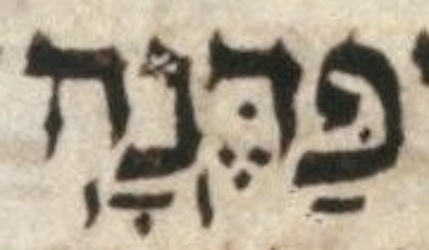 Credit: Sefaria.org.
 Credit: Sefaria.org.
 Credit: Sefaria.org.
 Credit: Sefaria.org.
 Credit: Sefaria.org.
 Credit: Sefaria.org.
 Credit: Sefaria.org.
 Credit: Sefaria.org.
 Credit: Sefaria.org.
 Credit: Sefaria.org.
 Credit: Sefaria.org.
 Credit: Sefaria.org.
 Credit: Sefaria.org.
 Credit: Sefaria.org.
 Credit: Sefaria.org.
 Credit: Sefaria.org.
 Credit: Sefaria.org.
 Credit: Sefaria.org.
 Credit: Sefaria.org.
 Credit: Sefaria.org.
 Credit: Sefaria.org.
 Credit: Sefaria.org.
 Credit: Sefaria.org.
 Credit: Sefaria.org.
 Credit: Sefaria.org.
 Credit: Sefaria.org.
 Credit: Sefaria.org.
 Credit: Sefaria.org.
 Credit: Sefaria.org.
 Credit: Sefaria.org.
 Credit: Sefaria.org.
 Credit: Sefaria.org.
 Credit: Sefaria.org.
 Credit: Sefaria.org.
 Credit: Sefaria.org.
 Credit: Sefaria.org.
 Credit: Sefaria.org.
 Credit: Sefaria.org.
 Credit: Sefaria.org.
 Credit: Sefaria.org.
 Credit: Sefaria.org.
 Credit: Sefaria.org.
 Credit: Sefaria.org.
 Credit: Sefaria.org.
 Credit: Sefaria.org.
 Credit: Sefaria.org.
 Credit: Sefaria.org.
 Credit: Sefaria.org.
 Credit: Sefaria.org.
 Credit: Sefaria.org.
 Credit: Sefaria.org.
 Credit: Sefaria.org.
 Credit: Sefaria.org.
 Credit: Sefaria.org.
 Credit: Sefaria.org.
 Credit: Sefaria.org.
 Credit: Sefaria.org.
 Credit: Sefaria.org.
 Credit: Sefaria.org.
 Credit: Sefaria.org.
 Credit: Sefaria.org.
 Credit: Sefaria.org.
 Credit: Sefaria.org.
 Credit: Sefaria.org.
 Credit: Sefaria.org.
 Credit: Sefaria.org.
 Credit: Sefaria.org.
 Credit: Sefaria.org.
 Credit: Sefaria.org.
 Credit: Sefaria.org.
 Credit: Sefaria.org.
 Credit: Sefaria.org.
 Credit: Sefaria.org.
 Credit: Sefaria.org.
 Credit: Sefaria.org.
 Credit: Sefaria.org.
 Credit: Sefaria.org.
 Credit: Sefaria.org.
 Credit: Sefaria.org.
 Credit: Sefaria.org.
 Credit: Sefaria.org.
 Credit: Sefaria.org.
 Credit: Sefaria.org.
 Credit: Sefaria.org.
 Credit: Sefaria.org.
 Credit: Sefaria.org.
 Credit: Sefaria.org.
 Credit: Sefaria.org.
 Credit: Sefaria.org.
 Credit: Sefaria.org.
 Credit: Sefaria.org.
 Credit: Sefaria.org.
 Credit: Sefaria.org.
 Credit: Sefaria.org.
 Credit: Sefaria.org.
 Credit: Sefaria.org.
 Credit: Sefaria.org.
 Credit: Sefaria.org.